I really love to shed some light to the game whereas it doesn't shine enough.
I love a realistic city-building game that uses a non-rigid-grid system because IRL we don't have grids. We just freely draw things.
Therefore this game uses that. I'm going to list down things I love and what I wish this game would have.
Likes
Infrastructure
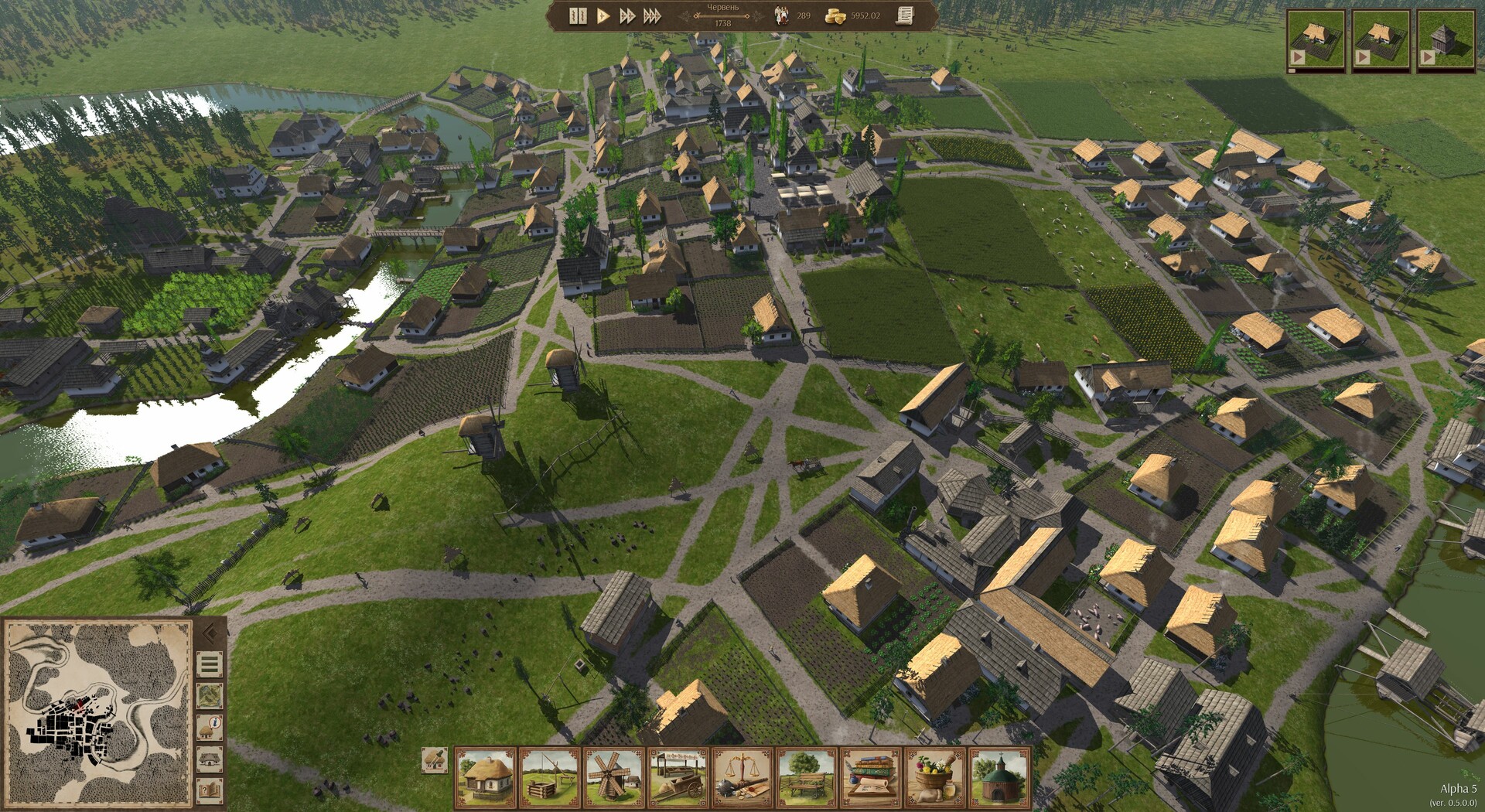
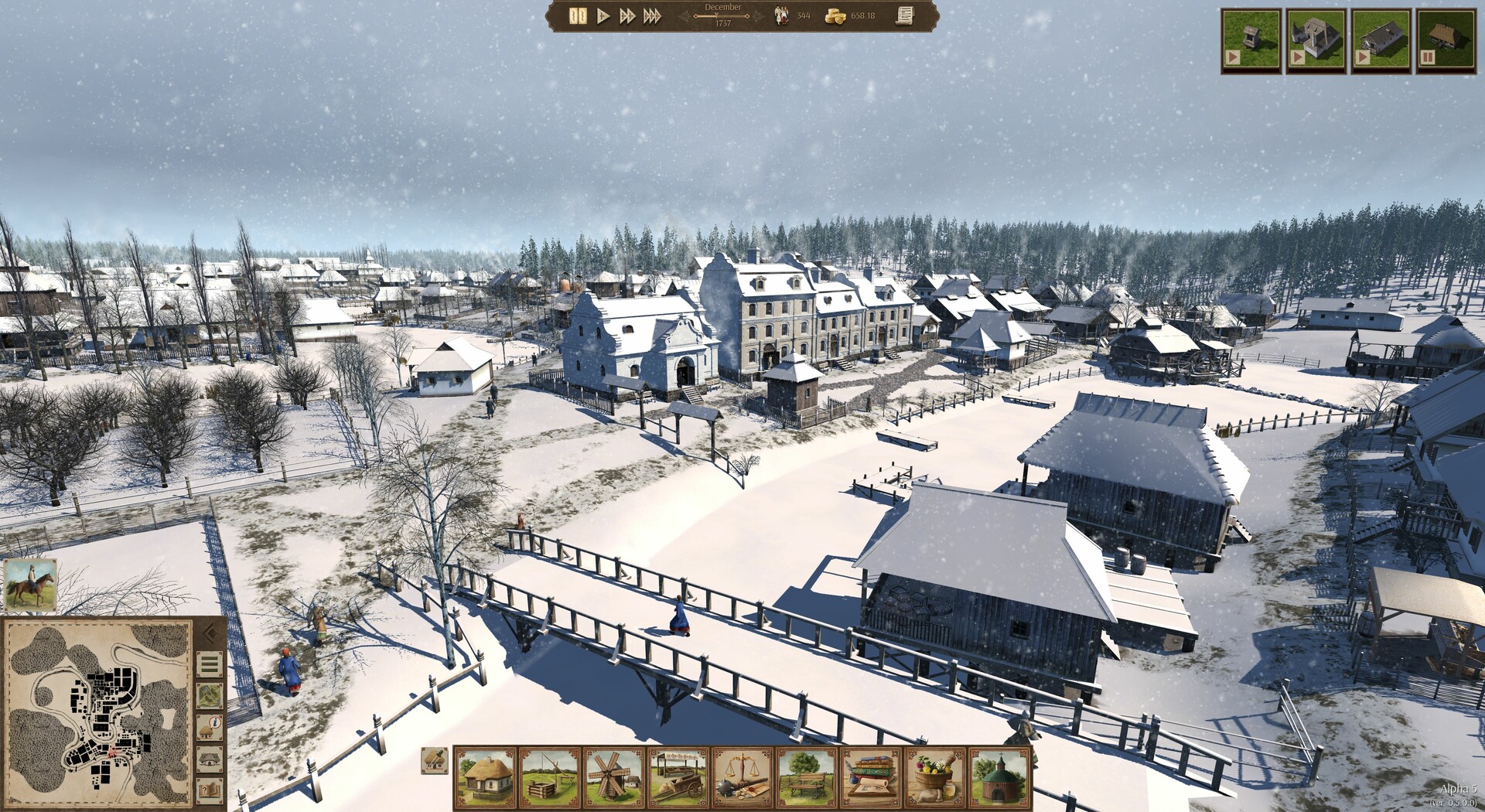
1. Grid-less building system. This is important to build along the terrain. hilly, river, valley, we can follow the flow. And your city skyline will look beautiful as it follows the terrain profile.
You can make your city looks organic and every building is built like a lego pieces. You can employ only one builder and he can still construct the building fast as this depends on your efficiency in your logistic system to deliver the building material to the sites. So the masterbuilder only needs to wait there and build it piece by piece. You can see the project management diagram and the timeline as it is constructed. When the wood is needed and when nail is needed.
2. Citizens walk-path creating a ground with lesser grass. Thus you can see the area in your town which are busier or not due to the grass-less ground. To me, I never found such mechanic in any city-building game except The Foundation. Though The Foundation is too cartoonesque and I dont really like the way it looks.
3. The resources system that is similar to Banished. Here you have to identify where your citizen is and know where to find a strategic area where a market the supply chain of a market is feasible. You can see what your citizen is selling on the table (its so much fun seeing your other citizens going and buying it)
So you can see the product being carried by a worker who can opt to carry with their bare hands (lesser quantity), or by cart. You need to build a cart shed where a carpenter needs to build and maintain those damn carts (because it breaks due to wear and tear) and a worker needs to attend the cart and on standby mode to deliver things across your busy town,
There is also wagon system where it needs a living horse. Yes, and the horse needs to be fed by hay and that hay needs to be harvested only on mowing season which is summer where it will dry on a hay dryer. Its so realistic that every part of your living city needs each other as it grow.
Economy
4. Economic system here is the nearest to the actual world. After playing this game, it helps me to understand better the basic economic system in the world we live in.
Every citizen have their own amount of savings and you pay their salary and tax them based on that amount of money circulating in your city. So in early stage, your citizen will be poor and will work any job if there is any vacancy. No matter how low the salary offered.
However, in late game, they will get richer and no matter how big your population is, you will have to tax them higher so that there is a tension and struggle for them to keep paying the tax and in return go outside, and work, this is why in a developed country, the tax is high and the economy is high, the income disparity is low. So they will work their ass off to pay your implemented tax.
This game taught me that a person needs to create value in order to prosper, the town needs to produce something and sell it to other region for it to prosper and get extra money circulate into the system.
4.1 Another thing is your citizen can sell things to you, and you can buy them and tax them. For example, there is a big ol land, first, you can charge them house rents like in Tropico. Second, you can tax their land size, and how do you think they gonna pay the rent? Yes, by selling produce that they grow on the land back to you, and you sell the produce like cucumber, pumpkins, and etc back to the other citizens. Isnt that fun.
It is a living economy system and its organic.
5. The production chain is complex (not complex enough that it tires and bore you to a chore)
Like I said, everything needs each other.
Farming
6. Farming system. In Ostriv, you have to apply crop rotation practice because the soil will be deemed useless once the nutrient is eaten by the crops harvested. and people back then uses cow dung as their organic fertilizer, so in an optimum situation. You need to rear cattle and let them eat and poop in one of your farm field to make it thrive again.
If you have multiple farms, you need to manually choose which farm to grow what and which cattle to eat and poop where, so you can hire a manager which bring us to the next point I love about Ostriv is that the function of a manager that can really be seen.
7. Managers. In other games, usually we hire manager just to make it more efficient by certain percentage and it can be translated in multipliers. But here, the manager really work and take away the multitasking so you dont have to. That is what a manager for right. Again, another realistic element. The manager will automatically implement your plan to grow which crops for the next season and next season.
8. Function of the managers. - Seasonal Hiring is another form that I love. This is to increase productivity and making your crops production more optimized as people in the past really romanticize the agriculture element because what do you want to eat if nobody is producing the food.
So, most citizen will not do anything else and only focus on growing foods. On early stage of your city development, food are scarce and your citizens are not many too. Therefore they cant work 2 job in one time. seasonal hiring is the solution.
So you can have the same citizen to work on your Smelter smelting iron ore during the off season, and working on your farm during on season. Therefore, you still pay them wages and they still in return provide you with the service for you to achieve your goal.
However, you cant engage a seasonal hiring system unless you hire a lady chancellor in your town hall. This is what people miss about when they creating a city building game or management game, they don't really put functionality in roles, be it governor, manager or a supervisor, etc. This game is an example when someone makes a game with love.
The developer shows that he truly understand what a city builder player wants. We perceive something as in real world. We want to work hard on early stage and will wish to be more relaxed in later part of our life. And focus to develop other parts later in a more relaxed way.
Same goes in game, we do things on our own and later we hire people to do it for us. This kind of mechanic is lacking in some management game although the name 'management'.
Dislikes
Although I hardly hate this game because it doesnt really bother me but its worth mentioning in order to improve this game further and so that it can be polished with every update and overhaul.
1. Linear path of the citizen walking. I rarely see any game in the world uses a system that if a citizen / subject of the city walks and collided with other citizens, it moves away to avoid being collided. Here in Ostriv, the citizen is walking in a straight line and still penetrates the other citizens. It is more realistic if carts and wagons also have to wait their turn to go through at an intersection.
This is also the same with the incoming carts and wagon from the outside town, it should wait their turn behind the other cart / wagon before doing business in the trading post / trading dock.
2. Lack of modular system in buildings. I wish the building have the options to build extra modular component and it can be used to increase efficiency or any other feature.
Maybe you can build a wagon shed and add an extra module for added wagon parking spot.
Or a farm with an extra dwellings where a laborer can live and sleep there during on season to increase efficiency.
or perhaps an up-gradable warehouse / granary / or production chain building which uses nearby extra space for the module to be built.
ps: I cant write anymore due to Steam limitation to this