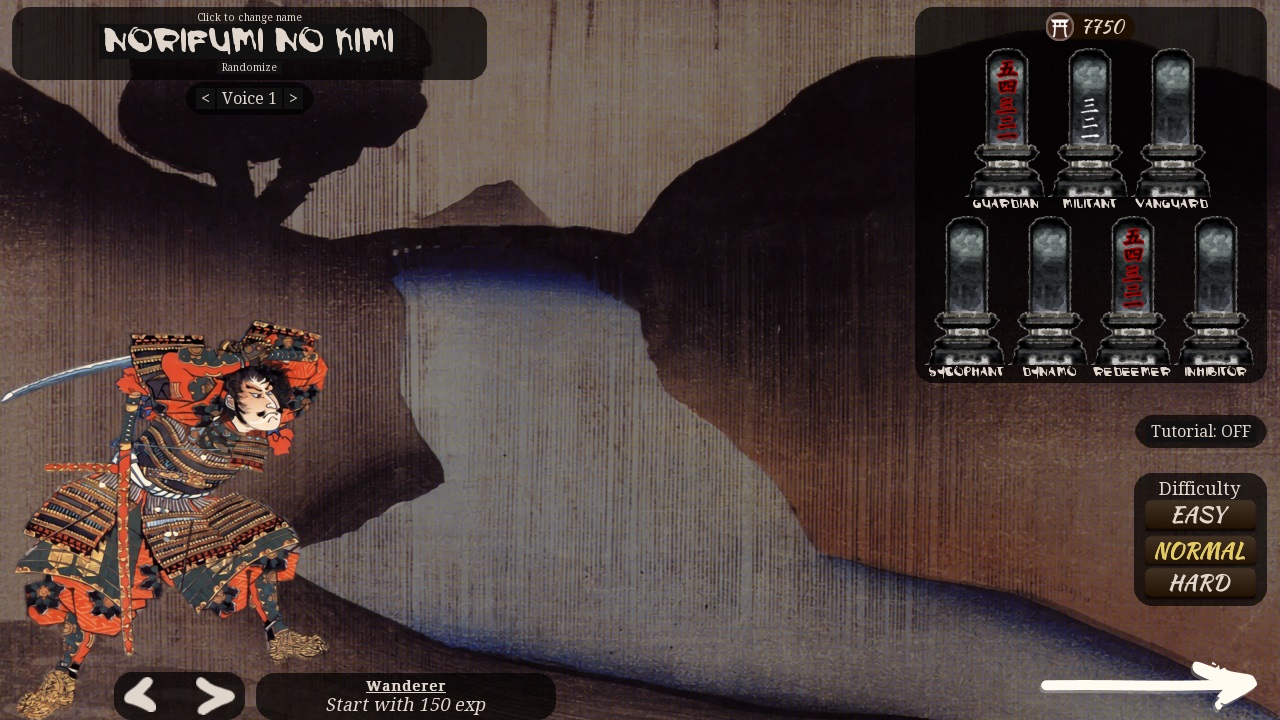
Shigatari is a rogue-lite game set in late-feudal Japan. Here you pick your hero from a selection of adventurers with various backgrounds - from a generic wanderer to a young noblewoman, or even a european foreigner, and lead them on their quest to defeat seven great sword masters.
The game has three core mechanics: dialogue, map movement, and combat. The dialogue system is straightforward, with a funny quirk: you can say "Die" and engage in combat in almost any encounter, be it a humble tailor or a group of well-armed warriors of the local government. For a good example of an "always-say-die" run, refer to [url=https://www.youtube.com/watch?v=QnZV38-QOF8s]the game's trailer[/url] - simple words fail to describe it. And while being tons of fun, it's a viable strategy too, and is also a way to unlock one of the characters. There are other surprises too: some actions you perform may be MOST DISHONORABLE, and after a while you'll have a good guess of what's honorable in samurai's ethics and what's not. Postpone the seppuku, though, unless you're in a mood for immersive role-playing - the debuff from DISHONESTY is not that bad. And be careful around supernatural beings!
After you resolve the encounter, either with words or steel, you'll get to the world map. First, you pick a region to explore [spoiler]they are persistent in their main features across walkthroughs[/spoiler] and then you explore locations within, moving from rice farms to towns over temples, and finally to the sword master you must defeat. The encounters have good variability - of course you'll see repetitions after several walkthoughs, but there are lots of ways to resolve each encounter, and some span through several locations, and moreover, selected few can affect your future walkthroughs. Whichever you find yourself in, these are interesting to read and play out: the descriptions are short and given mostly in dialogue form, there's always something unusual or peculiar going on, and there are lots of ways to resolve them either to your benefit, or, if you're feeling generous, to the favour of other people.
The way you deal with encounters earns you personality points towards several mutually exclusive characteristics, like being "courageous" vs being "prudent". Maxed out, they all give a considerable bonus to your combat prowess in one way or another, but much more important is the way these characteristics affect your options for encounters. A cunning ronin can come up with lots of tricks to make the upcoming battle easier, while a sincere one often can't help but openly and formally engage the oppenent or can tell truth and only the truth - which can be beneficial, too, if your opponent is as honest as you. This gives another layer of depth to your adventures - not only you need to plan whether you want to visit more waterfalls, or more beaches, or more towns, you also need to consider your character developing a personality that's slightly out of your control, which can be helpful, or detrimental to your efforts.
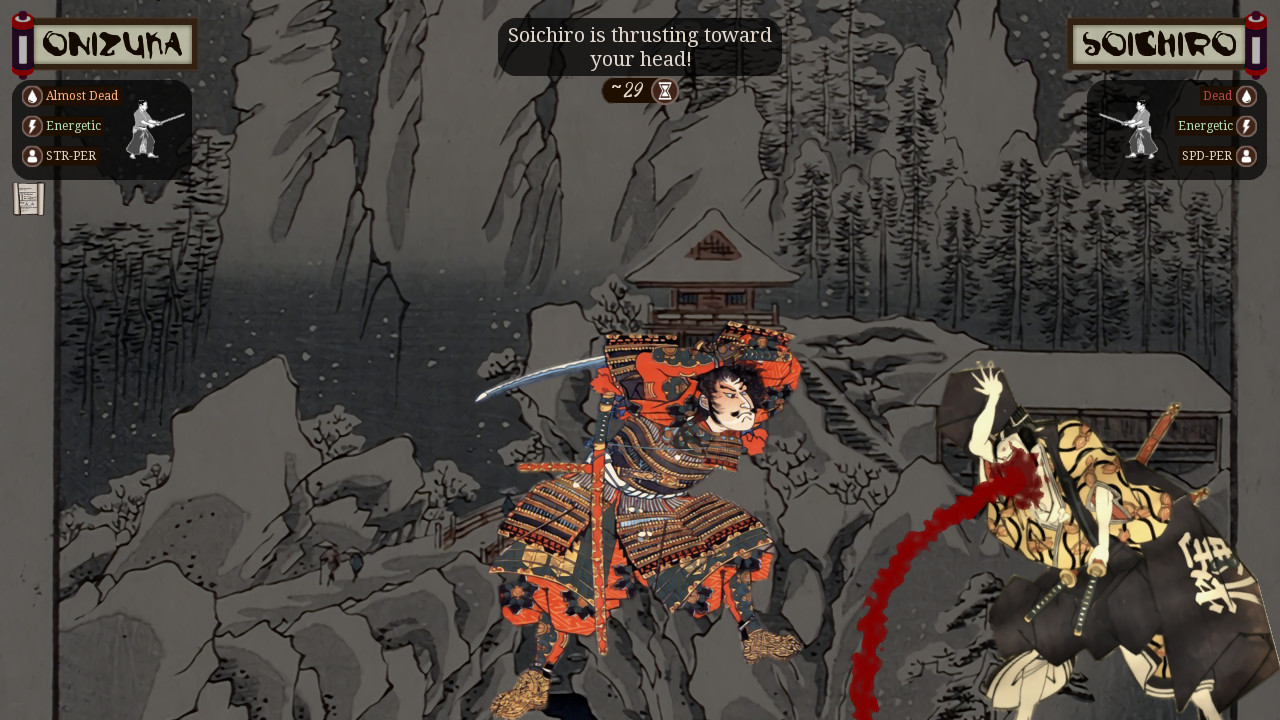
Sooner or later, willingly or by circumstance, you will have to draw your sword and engage in combat. You can start the game with the tutorial, but I found it a bit overwhelming and hard to digest and remember at once. Don't worry: practice makes perfect, just like in real life, and you have unlimited lives (meaning the number of your character's descendants, of course) for practice! And while writing an exhaustive guide on combat would be a bit too much for a review, I'll sneak in a couple of important tips.
So, what your master does not mention in the tutorial and what will keep you getting killed the most, is enemy feinting. Say for example that your opponent attacks somewhere "high" (that means head or one of the shoulders, but you can't make out where exactly) and there're 100 time units until the attack lands. If you parry it immediately, you'll get hit anyway. That's because, just like you, your enemy can change the attack about 10% of time into it - 10 units in this example. And he will. So, before doing anything, you need to wait for some time - a couple of "blinks" will do. And if there's not enough time to wait *and* parry, try to change stance to one where parrying requires less time (Hasso is good is this regard), dodge, or brace for impact, if everything else fails.
Once you stop getting your limbs chopped off by random thugs, the vast sea of possibilites and tons of fun will open before you. It's time to try out several different styles of offense and defense, using various combinations of attributes and stances. Take some time to read descriptions in the abilities screen to get an idea of how to develop your character. Shigatari is a rare case where there are no unviable options - you can make any combination of masteries and attributes work. You can even develop several branches at a time, as some masteries specifically encourage you to change weapons or stances during combat.
After clearing about a half of the regions in a run, you may start feeling too powerful - well, that power is well deserved. Now your character can effortlessly slay most common opponents. This may seem somewhat imbalanced, but I find it a part of the charm - after all, when you've successfully challenged and killed some of the great masters, a lesser warrior is no match for you. To compensate, you can always start the next run on a higher difficulty, where even thugs will have some tricks up their sleeves. And the seven masters will always provide you with some challenge, no matter how well you're prepared. Actually, they even encourage you to branch out in your skills, as some of them can be the exact counters to your main strategy, making it difficult, though not impossible, to execute.
But let's say you've dealt with all the masters and finished the game one way or the other. There's still lots of things to do in Shigatari - like unlocking new characters. This is a fun on its own, as the unlocking conditions require you to do some very specific, but not grindy things, like drinking some "gaijin sake" while wearing "gaijin armor" and wielding a "gaijin sword" to unlock a dapper-dressed european foreigner. These conditions usually require you to play the game in an unexpected way, which adds to fun. And unlockable characters are even more fun to play - the foreigner mentioned above is a whole other experience!
There's not much to say about graphics: it's made almost exclusively from the cut-outs of Japanese art of the era. Hardly anything is animated, but there are nice and funny effects here and there, like the animations for fatal strikes. The music, though it consists mostly of drums and some jingles made with traditional Japanese instruments, actually works - just tone it down a bit so the massive drums won't hit your ears too hard.
Saying all of that, it's MOST DISHONORABLE that not a lot of people have played Shigatari. According to Steamspy at the time of this review, the sales are just around 1k. This game is well worth its price and I think even more.
P.S. For more awesome hidden gems, follow the steam [url=http://store.steampowered.com/curator/10722089/]CRIMINALLY Low Sales[/url] curator.