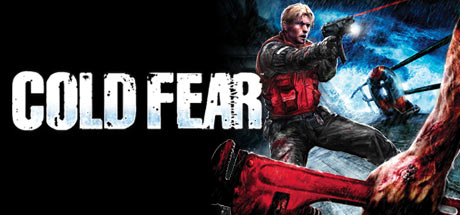
COLD FEAR - You might want to read the manual.
GRAPHICS
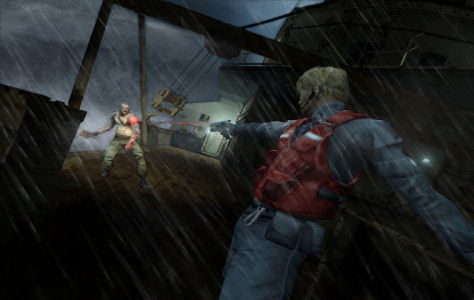
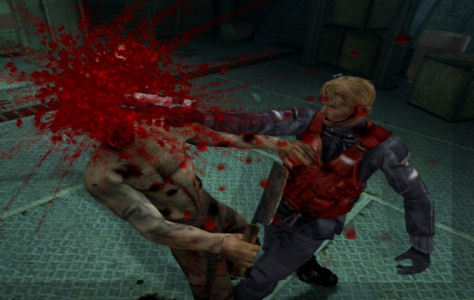
For a 2005 PC game, are great and hold up well, helped by the widescreen patch, which makes them look better. They are just enough for what is needed for this type of video game. The color palette fits the setting and atmosphere very well, and I think its application in the game is very successful.
CONTROLS
The control scheme is complex, but brilliant. You either love it or hate it. You can actively choose whether to play the game with dynamic fixed cameras in a 3D environment (like Resident Evil Code Veronica), or if you prefer to observe the environment and adopt the "over-the-shoulder camera" gameplay like in Resident Evil 4. The way you can flow from one mode to another is what makes it interesting; it's not a choice before starting the game, it's not an option to activate in a menu. By pressing the right mouse button, you activate the OTS aiming mode, while by default with SHIFT, Hansen will raise his weapon aiming as in a classic Resident Evil, although this last mode can limit the control you have over the aiming, since aiming with SHIFT uses a "lock on target" system that locks on the nearest target. Additionally, it's worth mentioning that when aiming with SHIFT, Hansen will stop walking freely and will always look in the direction in which we are aiming with the mouse. The combination of these factors will make many players end up always aiming with the right click, sacrificing completely the SHIFT aiming.
ENVIRONMENT AND SETTINGS
The setting must be the game's strong point. The whaler represents a perfect mix of labyrinthine corridors, claustrophobic rooms, and unsettling corners behind which an enemy may be hiding. The rain, the rocking of the boat, the dangerous hanging hooks and crates... Everything adds up to a puzzle that is a work of art for this genre of video games and a strong point in favour of this title.
VARIETY OF ENEMIES AND ENVIRONMENTAL DANGERS
The lack of variety in enemies is one of the biggest shortcomings of the game, especially considering the large number of enemies that appear in the game's concept art. Throughout the game, we only encounter six types of enemies, and some of them have limited appearances (although very well-executed). On the other hand, the lack of enemies is balanced with the appearance of environmental dangers, such as hooks and crates hanging that, upon impact will take away a significant amount of health. We will also need to watch out for the waves that hit the ship, as a well-loaded wave can violently push Hansen against the walls, seriously injuring him. We also need to watch our steps on the whaler, which, rocked by the waves, can make us slide and crash hard against walls, or in worse cases, send us overboard. To avoid becoming victims to the waves and gravity, Hansen must grab onto anything he can with the appropriate button, which will hold him in place and prevent him from sliding. In addition to "natural" dangers, we will need to watch our step because we will encounter traps and tricky situations, such as a room full of explosives and the ease of detonating them while defending ourselves. I won't go into detail to respect the reader's gaming experience.
STORY
The story is rather generic, with notable flaws and plot holes that are hard to ignore if we pay even minimal attention. In the first 10 minutes of gameplay, we see a paramilitary team boarding an apparently abandoned whaling ship to investigate something, and they are suddenly surprised and defeated by unknown creatures. Then our hero comes into action with his own team to investigate what happened. His team is also eliminated, leaving him alone to investigate the area, putting us now in his shoes aboard the whaling ship. As we progress in the first 10 minutes of gameplay, we discover that it is not a whaling ship, but a cover for a Russian scientific-military operation.
Speaking without spoilers: One of the most notable flaws in the game's story is that some details that are important and key during the first half of the game have not been explored, explained, or sustained towards the end of the game. A certain character, suddenly disappears without really closing their role in the game, leaving a gap in the final segment that leaves a strange taste in mouth. Also another matter of vital importance is completely ignored towards the end.
As I write this and think, I have realized that one of the possible causes of these incoherencies in the narration may be a sudden change in the script towards the end of the game.
CHARACTERS
Unfortunately, the characters are generally flat and one-dimensional. But what is most notable is that the villains introduced in the game, as quickly as they appear, are just as quickly forgotten, with forgettable performances. They lack real depth or presence in the game, and their appearances are almost exclusively limited to written documents or death scenes that coincide with their first appearance in flesh and bone. Hansen, has a hint of depth that is exposed to the player in a conversation, but it is soon forgotten and completely abandoned by the game's narrative, limiting this depth to two sentences that, if not read in the manual, leave the player bewildered as to what they could possibly mean.
GENERAL GAMEPLAY:
The ship setting seems very fitting for this type of game, with a strong sense of isolation and desperation, coupled with the swaying of the ship, which makes it difficult to aim at enemies' heads. The game never provides a map to consult, so players must find their way by paying attention to character conversations or reading the documents they come across. This is by design, as to locate ourselves on the ship, we must read signs that are only translated by Hansen when we aim directly at one. I believe this choice was well made, forcing the player to locate resources and objectives more realistically and not allowing us to rely on a magical map that constantly indicates our location, something I have been guilty of relying on in many games before, and thus initially surprised me. As mentioned above, the controls allow us to choose between two modes of play at any time, allowing us to play the game as we please. This has been a very interesting and entertaining experience for me, sometimes forcing myself to avoid the use of one camera or another. Exploring environments in one mode and then in the other, and seeing the constant changes in perspective, may be disconcerting for some players, but it has been very fun for me.
READ THE DAMN MANUAL (Included in steam):
From describing actions, to giving backstory to enumerating dangers, the player will benefit greatly from reading the manual. Among other things, it contains a map that the game never shows at any time or place.
REPLAYABILITY:
There are no unlockables beyond the concept arts in the main menu and the higher dificulty. I have not found an extra weapon, an alternative look or whatever. This is quite sad in a Survival Horror game where replayability is often a must.
CONCLUSION:
Cold Fear is a survival horror title from the early 2000s that has aged decently graphically. The story is what we can expect from a title from that era, with typical genre cliches and a few difficult-to-ignore plot holes, but these do not detract from the gameplay experience. The limited variety of enemies, while not excusable, is balanced by the environmental hazards that we must navigate. The Spanish translation is mediocre, and the dubbing is the same. The setting and gameplay experience, tied to the controls and atmosphere obtained from the environment in which the events unfold, are, in my opinion, the strong point of this title, allowing us to forgive all the flaws in favor of a fun adventure where scares and nerves abound. The final boss, on the highest difficulty level, is an absolute son of a ****.